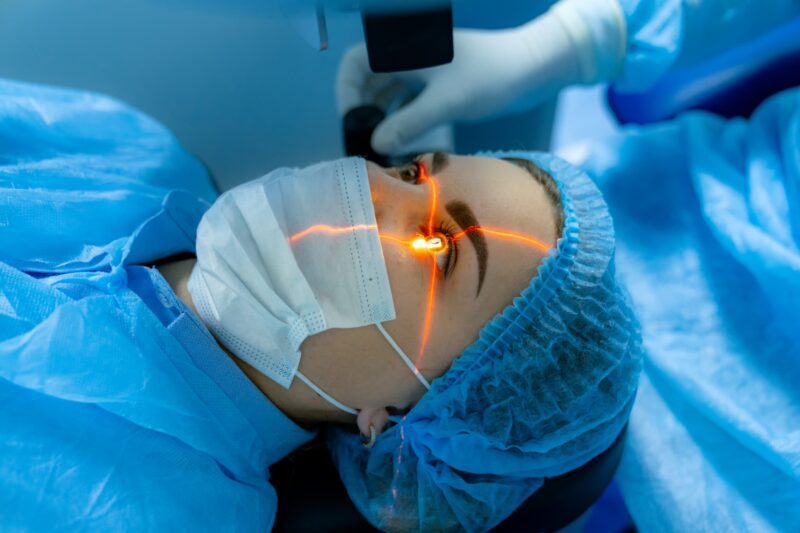
Cataract surgery has evolved significantly over the past several decades, giving patients more options than ever for improving their vision. One of the most important advances is laser cataract surgery, which adds computer-guided laser technology to certain critical steps of the cataract procedure.
At Eye Care Professionals, eye surgeon, Dr. Mills has extensive experience with both traditional and laser cataract surgery. In fact, our practice was at the forefront of bringing this technology to Nevada, with Dr. Mills becoming the first in the state to perform laser cataract surgery more than 15 years ago.
So, what exactly is the difference between laser cataract surgery vs. traditional cataract surgery, and what are the potential benefits of choosing the laser-assisted approach?
What Is Traditional Cataract Surgery?
Traditional cataract surgery is performed manually by your eye surgeon. During the procedure, precise incisions are made in the eye so the clouded natural lens can be removed and replaced with a clear intraocular lens, or IOL.
Traditional cataract surgery has a long history of success. Experienced cataract surgeons have performed tens of thousands of these procedures and can achieve excellent results using manual surgical techniques.
Laser cataract surgery does not replace the skill or experience of the surgeon. Instead, it provides an additional level of technology that can be used during some of the most critical portions of the procedure.
What Is Laser Cataract Surgery?
Laser cataract surgery uses a femtosecond laser that allows the surgeon to program certain critical incisions into a computer before they are created. Once programmed, the computer-driven laser creates these incisions with an extremely high degree of precision. This adds three important elements to cataract surgery:
- Automation
- Computer guidance
- Enhanced precision
Rather than relying exclusively on incisions created manually by hand, laser cataract surgery allows the surgeon to use sophisticated technology to perform specific steps of the procedure.
What Are the Benefits of Laser Cataract Surgery?
One of the primary benefits of laser cataract surgery is precision. The femtosecond laser allows certain incisions to be programmed and created with a level of precision that cannot be replicated by hand.
The precision of these incisions can have an impact on a patient’s visual outcome, which is why laser technology may be particularly valuable when the goal of cataract surgery extends beyond simply removing the cataract.
Today’s cataract surgery can also be an opportunity to address other aspects of a patient’s vision and reduce dependence on glasses after surgery. Laser technology gives the surgeon another tool for customizing the procedure around those goals.
Can Laser Cataract Surgery Correct Astigmatism?
Another significant benefit of laser cataract surgery is the ability to address certain levels of astigmatism during the cataract procedure. For patients with lower levels of astigmatism, the femtosecond laser can be used to make precise incisions designed to help correct the astigmatism. Patients with higher levels of astigmatism may instead benefit from a toric lens implant, which is specifically designed to correct astigmatism. In some cases, Eye Care Professionals may combine a toric lens with femtosecond laser cataract surgery to achieve the desired vision correction.
The best approach depends on the amount of astigmatism present and the patient’s individual eyes and vision goals.
Is Everyone a Candidate for Laser Cataract Surgery?
No. Although Eye Care Professionals can perform laser cataract surgery for most patients, the procedure isn’t appropriate for everyone. Certain anatomical factors, eye conditions, and previous surgeries may make traditional cataract surgery the better option.
For example, a patient whose pupil does not naturally dilate enough may not be compatible with the laser. Certain ocular surface conditions can also affect candidacy. Previous eye surgery is another consideration. Laser cataract surgery may be more difficult for patients who previously underwent radial keratotomy (RK).
For these reasons, the decision to use laser technology is made on a case-by-case basis after a thorough evaluation of the patient’s eyes.
Can You Have Laser Cataract Surgery With a Premium Lens?
Laser cataract surgery can be used with a variety of lens implants. The appropriate combination depends on your eyes and what you hope to achieve with cataract surgery. For example, patients with higher levels of astigmatism may combine laser cataract surgery with a toric IOL.
Laser cataract surgery is also used extensively when Eye Care Professionals implants a Light Adjustable Lens (LAL). With Light Adjustable Lenses, our surgeons will perform laser cataract surgery in nearly all cases.
This ability to combine advanced lens technology with laser-assisted surgery gives patients more opportunities to personalize their cataract treatment.
Does Insurance Cover Laser Cataract Surgery?
Cataract surgery itself is generally covered by insurance when it is medically necessary and the patient’s plan requirements are met. However, there is an important distinction between medically necessary cataract surgery and elective upgrades designed to provide additional vision correction. If a patient chooses a lens implant other than a standard lens implant, that is typically considered an elective upgrade. Laser cataract surgery combined with astigmatism correction is also considered an upgrade.
Depending on the treatment plan, these advanced options may be bundled together so that the costs of the lens technology, laser treatment, and astigmatism correction are combined. Our team will review your options and associated costs with you before surgery so you can make an informed decision about your treatment.
Laser Cataract Surgery vs. Traditional Cataract Surgery: Which Is Right for You?
Both traditional and laser cataract surgery can be excellent options. The biggest difference is that laser cataract surgery adds computer-guided automation and precision to certain critical portions of the procedure and can provide additional opportunities for astigmatism correction.
However, more advanced technology doesn’t automatically mean that laser cataract surgery is the right choice for every patient.
Your surgeon will consider factors such as your eye anatomy, pupil dilation, ocular surface, previous eye surgeries, amount of astigmatism, lens implant selection, and overall vision goals when recommending the best approach.
At Eye Care Professionals, we believe cataract surgery should be customized to the individual patient. We’ll explain the differences between traditional and laser cataract surgery, discuss your lens implant options, and help you understand which combination of technologies may best support your vision goals.
Learn More About Laser Cataract Surgery in Reno
If cataracts are beginning to interfere with your vision, the first step is a comprehensive cataract evaluation. The team at Eye Care Professionals in Reno, Nevada, can determine whether you are a candidate for laser cataract surgery and help you explore the cataract lens options available to you.
Schedule a cataract consultation with Eye Care Professionals to learn whether laser cataract surgery is right for your eyes and your vision goals.